


Let’s be honest for a second. As a leader at a Destination Marketing Organization (DMO), you’re living in a paradox.
You’re expected to deliver world-class, nation-building results. You see the reports from organizations like Destination Canada showing a mind-boggling $23.85 return on every marketing dollar invested, and your board of busy local business owners sees it, too. But you’re also trying to achieve that magic with a median budget of just $1.77 million and a mighty team of 17 people.
It’s the DMO Performance Paradox, and it’s the reason you’re probably drinking your double-double a little stronger these days.
The answer isn’t a bigger budget—that’s a fantasy. The answer is smarter tools. The challenge is that while amazing national initiatives give you access to incredible data, they don’t give you the extra hours in the day or the data scientist on staff to actually use it.
This article is your way out of that paradox. This is your practical, step-by-step guide on how any DMO, regardless of size or budget, can use a simple toolkit of free AI to bridge that gap, build a sophisticated visitor persona, and start making data-driven decisions that get your board nodding in approval.
Canada’s National Treasure Chest: The Data You Can’t Afford to Ignore

First, let’s talk about the goldmine you’re sitting on. The Canadian tourism sector has a revolutionary tool at its disposal: the Canadian Tourism Data Collective (CTDC). It’s a national data platform that centralizes over 25 billion rows of data from thousands of regions. It’s designed to give everyone from national bodies to the smallest local operator access to world-class intelligence.
Think of it as a national treasure chest, packed with insights about who is travelling, where they’re going, and what they’re looking for. The data is there for the taking.
But for a small DMO, opening that chest is the real challenge. This creates what we can call the “Application Gap”—the space between accessing data and being able to apply it. It’s like being handed the key to the national bank vault but having no map to find the specific safety deposit box that holds the treasure for your town. That gap is the real bottleneck for most DMOs, and it’s where AI becomes your new best friend.
The Pro’s Secret: It’s Not Who Visits, It’s Why
Before we open the toolkit, we need a crucial mindset shift. For decades, marketing was about demographics: age, income, location. Today, the leading organizations have moved on. They focus on psychographics: values, motivations, interests, and pain points.
Why? Because campaigns built on deep, psychographic personas have been shown to increase marketing-generated revenue by a staggering 171%. When you know why people travel, you can stop shouting into the void and start having a meaningful conversation.
You don’t have to look far for inspiration:
- Destination Canada: They’ve pivoted to focusing on “Highly Engaged Guests,” identifying traveller types who align with Canadian values, like “Culture Seekers” and “Outdoor Explorers.”
- Travel Alberta: They masterfully target the “Curious Adventurer,” a persona who wants to “learn all they can about a destination through its landscapes, authentic culture and the people they meet.”
This is the level of detail that drives results. And this isn’t just for the big players. The beauty of this approach is that it scales down perfectly, whether you’re promoting a province or a single summer festival. And now, you can achieve it without a seven-figure research budget.
Your Free AI Toolkit: Building a Persona Without a Data Scientist

It’s time to stop thinking of AI as some complicated, futuristic tech. For ‘DMO Mike’, it’s best to think of these tools as Virtual Staff Augmentation. They give you the capabilities of a data analyst and a market researcher, for free.
Here are the three tools you need to build your own “Curious Adventurer.”
Tool #1: Your AI Research Assistant (Google Gemini)
The Job: Your first step is to turn raw information into initial insights. You’ll use a powerful large language model like Google Gemini (or ChatGPT) to act as your tireless research assistant.
How to Use It:
1. Feed it data: Copy and paste online reviews of your region’s top attractions from Google or TripAdvisor.
2. Give it a prompt:
"Act as a market research analyst for a DMO. Read all of these visitor reviews and identify the 5 most common emotional drivers for why people visit. What were their biggest delights? What were their biggest frustrations or pain points?"3. Analyze competitors:
"What are the main marketing messages for the DMOs in [neighbouring region A] and [neighbouring region B]? Based on their websites, who are they trying to attract?"The Output: In minutes, you’ll have a synthesized report of core motivations, pain points, and competitive positioning that would have taken days to compile manually.
Tool #2: Your AI Persona Architect (The Pro Method)
The Job: Now you need to give your raw research a professional structure. A great persona isn’t just a list of facts; it’s a story. For this, we’ll use AI to blend two powerful marketing frameworks: Digital Marketer’s Customer Avatar and Donald Miller’s StoryBrand.
- Customer Avatar gives us the structure. It pushes us to get specific about our visitor’s goals, challenges, and values.
- StoryBrand gives us the transformation. It helps us map out the visitor’s emotional journey from a “Before” state (e.g., stressed, bored, overwhelmed) to an “After” state (e.g., relaxed, inspired, connected).
How to Use It: You’ll use your AI assistant again, but this time with a highly structured prompt that acts as a blueprint for a world-class persona.
Canadian AI Guy’s Pro Tip: Here’s the prompt we use internally. Copy and paste this into Gemini or ChatGPT, fill in the blanks with the research you gathered in Tool #1, and watch the magic happen:
"Act as a world-class marketing strategist. Create a detailed visitor persona for our DMO based on the following research summary: [Paste your research summary from Tool #1 here].

Structure the persona using the following framework:

1. Name & Photo Concept: Give the persona a memorable name and a concept for a stock photo.
2. Core Goals & Values: What is this person trying to achieve with their trip? What do they value most in a travel experience?
3. Challenges & Pain Points: What are their biggest frustrations when planning or taking a trip?
4. The StoryBrand Transformation:
The "Before" State: Describe their life right before the trip. How do they feel on an average Tuesday? (e.g., "Stuck in a routine, tired of the same old takeout, endlessly scrolling.")
The "After" State: Describe how they feel on the trip back home. What has changed? (e.g., "Reconnected with their partner, has a camera roll full of memories, feels inspired and refreshed.")
The Output: A rich, detailed, and emotionally resonant persona document. It’s a strategic asset that goes beyond data to tell a story—the exact kind of story that will get your board excited and make your marketing a thousand times more effective.
For a Simpler Start: If you prefer a more guided, step-by-step web form, HubSpot’s “Make My Persona” tool is still a great, simple option to get the basics down.
Tool #3: Your AI Behaviour Detective (Google Analytics)
The Job: Your persona is based on what people say. Now it’s time to add a layer of what people do. The free, AI-powered insights in Google Analytics 4 (GA4) are perfect for this.
How to Use It:
- Log into your GA4 account and look for the “Insights” card on your home dashboard.
- Ask it simple questions in plain English, like: “What are my top 5 most visited pages this month?” or “From which cities do I get the most website traffic?”
- Look at user behaviour. Are they visiting your “Hiking Trails” page more than your “Fine Dining” page? That’s a crucial piece of data that either validates or challenges the persona you’ve built.
The Output: Real-world data that adds a crucial layer of evidence to your persona, turning it from a smart assumption into a proven asset.
From Overwhelmed to Empowered
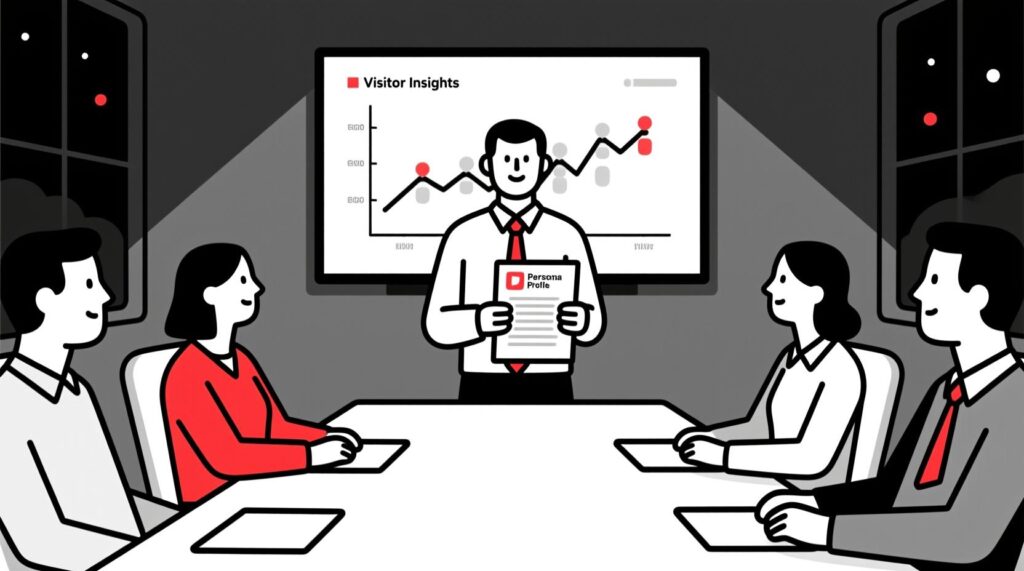
You don’t need a massive budget or a team of analysts to be data-driven. The gap between your DMO and the national bodies isn’t as wide as it seems when you have the right toolkit.
With these three free AI tools, you can stop guessing what your visitors want and start knowing. You can build a persona that is just as insightful as the national ones, but with a critical advantage: it’s tailored specifically to your unique destination. You can walk into your next meeting with a clear, evidence-backed answer to the most important question: “Who are we talking to?”
This persona is the foundation of a smarter marketing strategy. When you’re ready to learn how to plug this asset into your content creation and campaign planning, our AI Training Programs are the perfect next step.
For now, you’ve just taken the most important step. You’ve moved from being a marketer to being a strategist—and the most informed person in the room.
People Also Ask
1. What is a visitor persona in tourism marketing?
A visitor persona is a detailed, semi-fictional profile of a key type of visitor. It goes beyond simple demographics like age and location to include motivations, values, travel habits, and pain points, giving marketers a clear picture of who they are trying to attract.
2. How can free AI tools help a DMO with a small budget?
Free AI tools act as “virtual staff augmentation,” allowing small DMO teams to perform complex tasks like data analysis, market research, and content creation that would normally require specialized staff or expensive software.
3. Are there really free tools to create professional customer personas?
Yes. Tools like HubSpot’s “Make My Persona” are completely free and guide users through a structured process to create a professional, shareable persona document without any cost.
4. Why is data so important for modern destination marketing?
Data allows DMOs to move from “gut-feel” marketing to evidence-based strategies. It helps them understand visitor behaviour, personalize campaigns, and most importantly, prove a clear return on investment (ROI) to stakeholders and funders.
5. What is the Canadian Tourism Data Collective (CTDC)?
The CTDC is a national, AI-powered platform created by Destination Canada and its partners. It centralizes billions of data points to provide the entire Canadian tourism sector with access to high-quality data and insights to help them make smarter business decisions.
Share this:

Read more:

The 5-Minute AI Fix: Write Your Social Media Posts for the Entire Week

How to ‘Talk’ to AI: A Small Business Owner’s Guide to Better Conversations